Coach travel along the Darling, and the inevitable pub stopovers, were probably much less appealing than the advertisements by the coaching companies and hotels along the routes would imply.
During C. Proud’s appraisal of trade on the Murray and Darling Rivers in 1888, he undertook the then arduous coach journey from Louth to Bourke, which certainly did not live up to his expectations. Proud wrote of the trip, during which it took over 24 hours to travel 30 miles;
“Coach travelling on the Darling does not afford sufficient charm and variety to cause those who have had one experience to yearn for a repetition ...
We arrived at an hotel about 2 O’clock in the morning and were told we would have to be on the way again at half-past-four. When we stepped on the verandah, there were six or eight men lying side by side, all more or less in a state of beastly intoxication. Inside the dining room were twelve to fifteen more rapidly approaching the same condition, quarrelling over the remains of two bottles of spirits which the publican had served them with before locking up the bar in order to have them fit to continue the debauch as soon as daybreak appeared. This individual was knocked up by the mail passengers after some trouble, but the only refreshment obtainable was some villainous compound dispensed under the name of dark brandy.
Eventually, we were shown into our bedrooms but the rowing and profanity indulged in would keep us awake if we had been drugged with opium. I have heard a good deal of swearing in my travelling the colonies, but for blood curdling profanity, indulged in at the slightest provocation, the Darling districts are “facile princeps.”
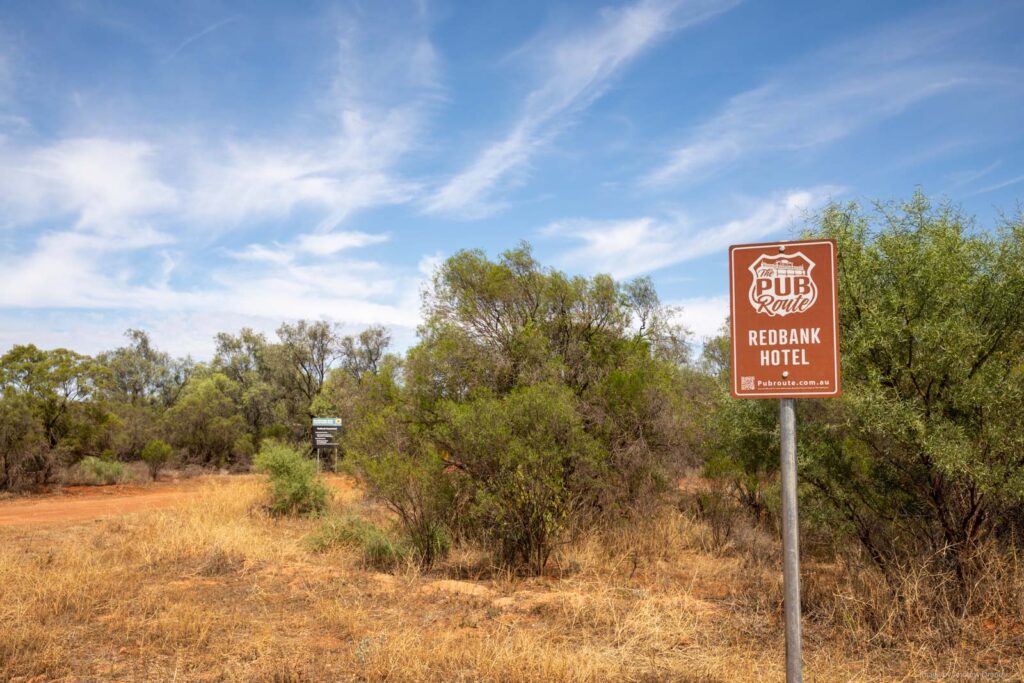
While Cobb and Co. were in control of Yanda in the early 1870s, a hotel, known as Redbank Hotel was established between the locations of what later became Redbank and Hamilton Park Homesteads. Located on a coach/telegraph route near the river, the first publican’s licence issued for the venue was to a John Doyle for the year 1872. Doyle had taken up a thin, rectangular selection of 40 acres at Redbank with partner Thomas Moses in the previous year. The hotel provided for the passing trade, which probably included steamers, stockmen and woodcutters, coaches and bullockies, travelling along the Darling from Bourke to Louth. In addition, the hotels often functioned as convenient exchange or drop off points for mail.
The period of operation according to licensing records and material presented in the History of Bourke, appears to have been from 1872 to 1902. John ‘Paddy’ Doyle ran the Redbank from 1872 to 1880 when his wife Julianna took over the licence and ran the hotel until 1883. Little is known about the hotel building or the actual operation of the Redbank Hotel during the period of operation by the Doyle’s. The little that we do know about the hostelry has been gleaned from a newspaper report relating to the burning down of the original hotel in 1876, and newspaper advertisements for its reincarnation in the 1880s.
On 7 December 1876, it was reported by the Town & Country Journal that the Redbank Hotel had been destroyed by fire after a kerosene lamp burst. Despite the fire fighting efforts of both Mr Hatten from Yanda and Mr Hood from Gundabooka, the building (presumably of wooden construction) could not be saved. The hotel was evidently rebuilt or moved as it was licensed again in the following year.
In the 1870s during the period of the licensee John Doyle, an advertisement was run in an as yet unidentified paper that read as follows:
Red Bank Hotel
JOHN DOYLE.
The hotel, so well known to the travelling public as the best within a range of many miles, is still kept by JOHN DOYLE.
Every requisite for TRAVELLERS can be obtained here, where the BEST TABLE in the district is kept.
Good oaten hay, excellent paddocks, and every accommodation at reasonable Rates. Splendid vegetables always to be had.
Redbank is now incorporated in the Gundabooka National Park (who kindly provided this information) and can still be found on site between Hamilton Park and Redbank accommodations.