

Like many mining towns, Shuttleton was ephemeral, flourishing for about twenty years. The Commercial, founded in 1902, was last licensed in 1908, while Tattersall’s, founded the same year, continued until the town itself died c1920. Its few remains are on private property, the cemetery with its 36 burial sites and six decaying headstones visited only by the occasional goat and haunted only by birdsong.
“Shuttleton is a lovely place… you can write your name in dust on the dinner plates any time you like.”
Lachlander, 11 January 1905
“…there are some good men there – they have to be to stand it.”
“Bar the luxuries of sand, ‘skeeters’, and sweltering sun, backed up by a thirst-producing reputation, Shuttleton is not too bad.”
A mining town may only live and breathe for a short time – Shuttleton’s lifespan was a mere 20 years – but in that time it is guaranteed it will have hotels.
Shuttleton, with a fluctuating population that barely reached 700 at its (brief) highest, had two, Tattersall’s and the shorter-lived Commercial. They were both born with the town, opening in 1902. The Commercial was licensed for the last time in 1908 while Tattersall’s stayed until 1920 when the last people left and the final candle was blown out. That was long enough for it to see a fair bit of fun, including the day in May 1913 when some race-goers thought to amuse themselves by blowing it up.
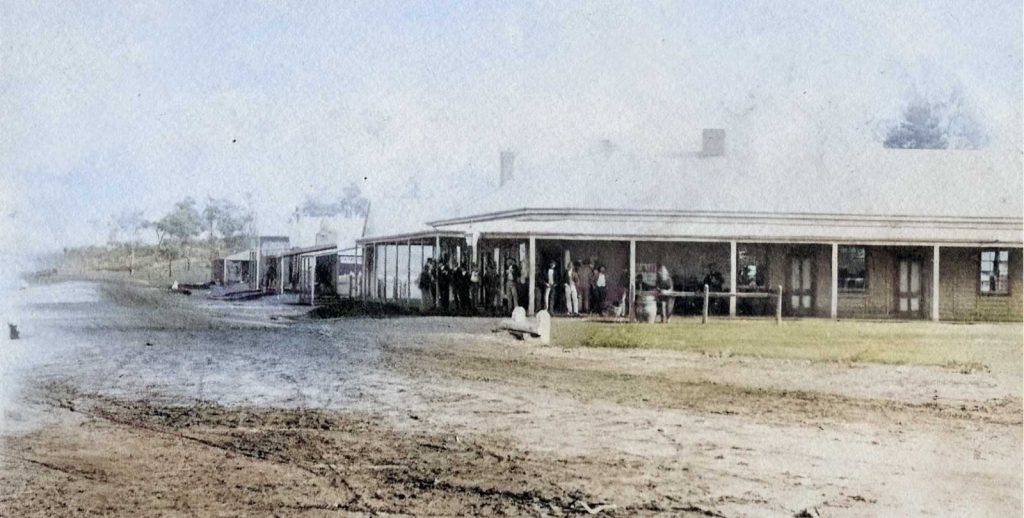
It being a mining town, no-one seems to have been too dismayed by this occurrence. The first of a mere two mentions occurs at the end of a long report on the Shuttleton races. Which horse ran and who won what seemed more important than the ‘outrage’ that was being investigated by the police. A couple of weeks later, they still hadn’t figure out who blew out the back wall of the hotel – and it seems they never did. Life went on.
In common with other hotels, Tattersall’s hosted all sorts of meetings and events. One of the more unusual was a wood chopping contest that took place in 1905. The victor took 3½ minutes to cut a log of dry gum 35cm in diameter in half (circumference of 1.1m). No doubt he worked up a thirst.
As well as the two hotels, Shuttleton had, at least briefly, a ‘wine shop’. This was only mentioned once and may have quickly faded. In 1902, when the two hotels and the wine shop co-existed, Shuttleton had a total of seven other stores, including a bakery.
In addition to this, a coach-line ran between the surrounding townships. Shuttleton’s ties with Nymagee were like those of conjoined twins and there is no doubt the people of each socialised and visited the hotels. Not far from Shuttleton, the Priory Hotel was considered close enough to be almost a part of the township. It was a staging stop, but also a meeting place for travellers and the surrounding district.
And if you’re wondering why it’s called Shuttleton – for Mr Shuttle, of course. Tom Shuttle, together with Jacky Owen, is credited with the first discovery of copper there.