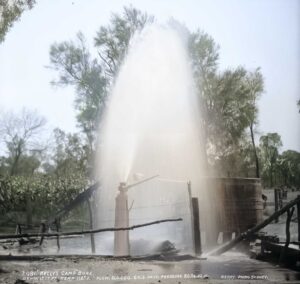
A ‘Colonial Wine Licence’ was granted for Kelly’s Camp in 1892 to Herbert White, and in April 1893 White was also granted a ‘Conditional Publican’s Licence’ for Kelly’s Camp.
Mrs. White was a daughter of Patrick Weldon, and their son (Born 1910) took the first load of wool to Sydney by truck. She had the Gumbalie Hotel, and later married T. Dykes who had the “Warraweena” at Dry Lake.
The Sydney Evening News reported in 1893 that;
“…Information has been received by the Mines Department that the artesian bore and Kelly’s Camp has been carried to a depth of 1500 feet, the supply of water being increased to 600,000 gallons per day…”
In the Australian Town and Country Journal, in a section dedicated to letters from children to ‘Dame Durden’, 15-year-old R. Stretton wrote in 1902;
“Springburn, Kelly’s Camp Bore,
Hungerford-road, via Bourke.
Dear Dame Durden, I now take the pleasure of dropping you a few lines, to relate to you a few Incidents of the far west of the Darling, or, called by Its sparse population, ‘The Never Never Country,” or, on account of Its feed, “The Mulga.” Nine miles from Bourke there is a bore. Then, for 26 miles, there ls nothing of any account, but a vast wilderness of mulga, gydyea, buddah trees, and sand.” At the 35-mile bore (Kelly’s Camp Bore) there ls a farm, and at that bore is the only green spot from Bourke to Hungerford. This bore gives out 600,000 gallons daily, and the heat of the water is 112deg. Forty one miles from Bourke there is a small township called Ford’s Bridge. There is a post office, hotel, police station, store, and a few Inhabitants… There is a sandhill between Kelly’s Camp and Ford’s Bridge, 7 miles, which horse and bullock teams seldom get over in one day. Wild ducks and black swans are plentiful on the lake supplied by the bore. Hoping this will meet with your approval, and if any of your readers would like to learn more of the Far West I will be able to supply more information.
-I remain, yours sincerely,
R. Stretton (15 years).”
To which the well-read Dame Durden published;
“(Dame Durden: Yes dreary though the Tale of the West is, we should like to hear more.
Dame Durden – 1902
The Little Laureate quotes Will. Ogilvie:
Where the mulga paddocks are wild and wide,
That’s where, the pick of the stockmen ride,
At the Back o’ Bourke.
Under the dust-cloud dense and brown,
Moving southward by tank and town,
That’s where the Queensland mobs come down
Out at the Back o’ Bourke.
Whether the plains are deep or dry,
That’s where the struggling teams go by,
At the Back o’ Bourke!
North and southward, in twos and throes,
Bullocks and horses down to the knees,
Waggons dipped to the axle-trees
Out at the Back o’ Bourke”.