

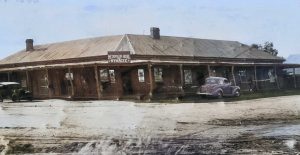
Established some 10 years after Cobar, Nymagee was a flourishing settlement reaching 2,200 at its peak, built around the enterprise of nearby copper and gold mines. Populated largely by Cornish miners (residing at the nearby ‘Cornish-town’) and boasting a significant population of Chinese, who worked at various individual gold mining pursuits, as well as a collective labour force cutting scrub and land clearing. There are known to have been five hotels in Nymagee with records of the: Traveller’s Rest, Royal Hotel, Metropolitan Hotel, Commercial Hotel, Club House Hotel and the Cardiff’s Arms.
The history of the brewery at Nymagee, short though it is (1881-1890 or thereabouts), illustrates the links between the Far West towns, the pubs and the publicans.
Nymagee was and is another mining town, its fortunes fluctuating with the ups and downs of the industry. At the time the hotel brewery was established, it had five hotels and a substantial population of uncertain numbers – there were numerous but uncounted Chinese people living in the area, working mostly as labourers and ring-barkers on the surrounding grazing properties.
The brewery was in Milford Street with its water supplied from a nearby tank that had originally been dug to supply a sawmill. This tank later became part of the town’s water supply and also watered the Chinese market garden, faint traces of which can still be seen.
Samuel Williams, who started the Marshall Street Brewery in Cobar, was the first brewer. He lived in Nymagee long enough for his wife to give birth to a child there. Samuel Williams was succeeded by a man called Mullard, previously working at a brewery in Girilambone, near Nyngan. The next proprietors were Lewis and Freeman, of the Young Castlemaine Brewery in Cobar, who knew a good business opportunity when they saw one in a thirsty mining town. They got out before the mining boom went bust, selling to Herbert Harris. Although other names are associated with the brewery, it remained in the Harris family through bankruptcy until the building finally burned down in 1894.
An Australian Town and Country Journal article from May 1888 described;
“There are five hotels in the town, the principal being The Royal (Mrs Simpson’s) where the coaches stop, and The Metropolitan (Mr Whitlock’s); and although Nymagee does not lie on the road to anywhere in particular, there is a large traffic through the town, principally to the mine, so that a very fair trade is done. One of the amusements of the young blood is to do the rounds, that is, to visit each of the pubs and to return home without getting drunk; and, strange as it may seem, this has been successfully accomplished on more than one occasion; while, as a set off, several who have attempted it have failed miserably, and had to be almost carried home. There is, however, much less of hard drinking in Nymagee than in many other country towns, and the police are not very often called upon to interfere…”
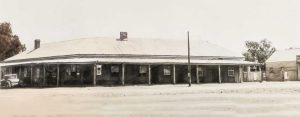
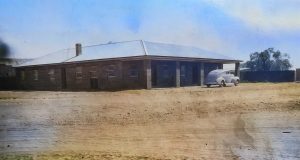
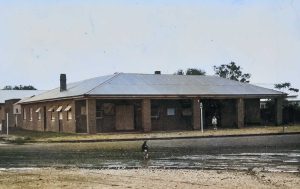
In The Western Champion, a Parkes newspaper of 1899, a report from Nymagee was filed in June;
“…On Saturday last, a wrestling match for £5 a side (Cumberland style) took place opposite Simpson’s Royal Hotel, between D. Simon and H. Snow. D. Simon was declared the winner. After the match was over, Mr. J. Kennimore collected, £10 for a wrestling tournament which will take place some time in June…”
While the Cobar Herald of the same year reported in January;
“….the death of Mr J. Smith, licensee of the Club House Hotel. The facts of the case are as follows : — Two men, Messrs Gooley and Hyland, after returning from a shooting party on Friday evening about 8 pm, walked into the bar of the deceased’s Hotel, Hyland carrying the rifle which had a cartridge in the barrel that was too tight to extract before entering the bar. He stood the rifle against the counter and was engaged in conversation with the deceased and Dr Cox, who were standing behind the bar, when, by some means or other, the rifle fell on the floor, the cartridge exploded, the ball passed through the counter and into Mr Smith’s leg, about two inches above the left knee, and passed out about half-way between the hip and knee on the opposite side. It was found embedded in the wall. He was carried to his room and upon examination it was found that the bone was completely smashed. The flow of blood was duly stopped, and a few minutes after death ensued; he only surviving an hour and a half after the accident, failure of the heart’s action being Dr Cox’s reason for such a sudden death…”
In other publications of the period, visiting cricket teams are welcomed and fed at hotels, billiard licences are granted, “and a booth licence was granted to John Sweeney of the Cardiff Arms Hotel, Nymagee, for the Hospital Races to be held on Boxing Day” as reported by the Cobar Herald in December 1904, who went on to further inform that:
“…a renewal of the publican’s licence of the Commercial Hotel, at Shuttleton, was granted to Mrs. Myrtle B. Reidy. Renewals of colonial wine licenses were granted to Patrick Purcell, of Shuttleton, and Arthur Boyse, of the Halfway House, on Nymagee-Hermidale Road.”
Today

Metropolitan Hotel
While the heyday of mining might be long in the past for the village of Nymagee, the Metropolitan Hotel is still the centre of a thriving community. It’s a fantastic spot to call in, catch your breath, and catch up on the local news.