

Wrightville included the village of Dapville but it was difficult to see where it ended and Cobar began. Trade passed between them on a daily basis, while football, cricket and rifle teams visited for competition and often celebrated or commiserated in the pubs.
The Family Hotel was first licensed in 1898 in the name of John Hunter. The hotel was aptly named as the hotel licence passed to Joseph Kelly in 1900 and then between members of the inter-married Kelly and Daley families for almost two decades.
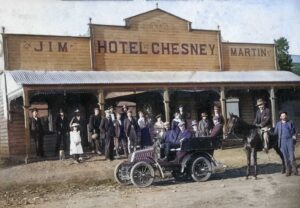
Two of Wrightville’s hotels, the Chesney and the Young Australia, were named for the nearby mines where much of their clientele worked. The Young Australia was the first known hotel in Wrightville, opening in 1896. Jim Martin, proprietor of the Chesney for three years, boasted he owned the first car in Cobar, proudly posing with it outside his pub.
In its 18-year history, Tattersall’s Hotel had ten licensees, three of whom were women. Hotels were one of the few businesses where women could be the acknowledged proprietress. However, this was not a role open to single women, only wives and widows. Helena Coates, the last female licensee of Tatt’s, died at New Year in 1918. Her boarder and odd-jobs man was so distraught at her loss he took his own life. She represented home, income, and all that he had that he could call family.
It was common to swap between pubs – Julia Rudge’s resoundingly-named son, Hercules, was for a time the licensee of the Chesney Hotel, as was John Hunter, who had started the Family Hotel.
All of these hotels relinquished their licences in 1920 when the end of WWI brought devastation to Cobar and its surrounding district. Some were demolished and others dismantled, packed up, and taken away for re-use elsewhere. Helena Coates’ sister, Jane Hutchinson, took apart the Tattersall’s hotel building and transported it to where she put it back together, all but the chimney-piece. She had to get someone to do that bit for her as she didn’t have the skills.
The Great Cobar Museum holds a large collection of beer and spirit bottles from locations around Wrightville. The most numerous are the Compass beer bottles. The extent of this collection of intact glass bottles indicates that there must have been many thousands more such bottles, long lost to history.