

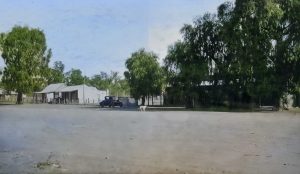
The Riverine Grazier of 12 April 1884 reported the suicide of a “native of the Celestial Land…a Chinese named Ah Sup…” , opening the paragraph with a charming description of the township as “… (one) which it would not be amiss to christen ‘Sleepy Hollow’…”
This excerpt from the Hillston Spectator in 1901 paints a vivid picture of the coach traffic and the use of hotels as changing stations;
“It is 18 miles from Cudgellico ( Lake Cargellico) to Euabalong, and approaching the latter place we pass a small area of very backward crop. Euabalong boasts of two well kept and comfortably appointed hotels, but it would be a long time between drinks if a man took them alternately at either hotel, for they are separated by about half a mile of box and gum forest. Mr. E. B. Carteis is the licensee of the Euabalong Hotel — the first you reach coming from Cudgellico, and opposite his premises is a large wooden building used, I understand, as a public hall. One or two private dwellings are also adjacent.
The Hillston Spectator and Lachlan Advertiser – 26 October 1901
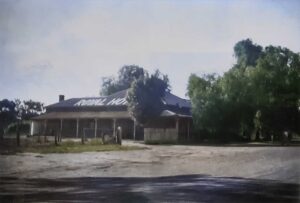
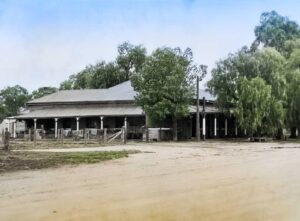
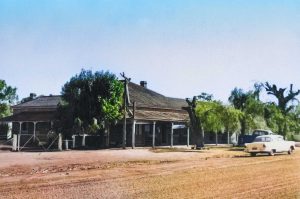
The principal business centre appears to be at the other (eastern) end of the settlement. Here Mr. H. Cabot — the pioneer business man of Euabalong — has the Royal Hotel, a commodious brick building, which is honestly one of the most comfortably appointed and best managed houses to be found in the whole district. Mr. Cabot also carries on a general store keeping business in premises opposite the hotel. The police-station and premises are neat and well kept, but the post and telegraph office struck me as rather small. The ‘village blacksmith ‘ should be doing well with the number of carriers on the road.
The rest of Euabalong consists of about a dozen houses and small enclosures. There is a splendid bridge across the river a few hundred yards from Mr.Cabot’s hotel, it being provided with a special footway for pedestrians. Just now Euabalong is a very busy little community. Nearly all the teams, and they are many, plying between Mount Hope and Condobolin, pass through Euabalong, and there is also a considerable amount of other traffic.
Mr. Buckley puts up at the Royal Hotel, as also does Mr. J. J. Cahil, who has the contract for the mail service between Euabalong and Condobolin. Mr. W. Budd is the mail contractor for the Mount Hope-Euabalong line, and he puts up at Mr. Curteis’. Some cultivation is carried on in the vicinity of Euabalong, and I was told that the crops on the average promised fair returns.
The correspondent for the Wagga Wagga Advertiser in May 1877 was less enchanted with Euabalong during his ‘Ramble Down the River’ reporting;
“…Euabalong is, without exception, a most forsaken and deserted-looking hole, though business is said to be pretty brisk there. Two public houses, a blacksmith’s establishment, a newly-built edifice intended for a public house, and a rather expensively-constructed store, happen to be the principal buildings in the place. Drinking here, I fancy, is not carried on to the extent that it is in Condobolin. The drinkers looked to me a more refined lot of men, and I did not see any rowdyism. Messrs. McLean and Cabot keep very good houses. I stayed at the former, and was very comfortably and hospitably treated…”
Wagga Wagga Advertiser – May 1877
We can certainly vouch for the fine drinkers of Euabalong, and completely refute the “god-forsaken hole” remark. Euabalong is a rare gem in the Cobar Shire, with cockatoo-filled shady gums lining the serpentine windings of the Lachlan River. A beautiful sleepy hollow.
Today

Euabalong Royal Hotel
Shady river gums line the banks of the Lachlan River, a home for corellas, cockatoos and kookaburras in the sleepy village of Euabalong. Nearby, however, the Royal Hotel is far from sleepy. It’s a busy, friendly hub for this small community, and is always ready to welcome visitors and locals alike through its open doors.