

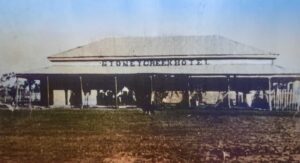
John Howell was a carpenter and built the original homestead at Winbar, as well as the hotel. He and Jane had married in Mildura some 17 years prior to opening the hotel in 1881, and the couple had 10 children together.
In 1885 their youngest child, Eliza Jane, died at just six years and four months of age. Grief-stricken, John died just months later and was buried next to his daughter at the foot of the ridge under a leopardwood tree. Family tradition has it that, without his young daughter, John didn’t want to remain on this earth.
Louth local and bush poet Wally Mitchell has a poem dedicated to the young Jane Eliza:
“Sad little maid on your lonely plain
Wally Mitchell
I come to visit you once again
May the soft spring rain for a hundred years
Warm your heart like a mother’s tears”
In 1886, aged 42, Jane married Charles Rodgers with whom she had another child.
Besides a brief period in Cobar, Jane remained at the hotel until around 1920.
When she died in 1937, aged 93, Jane had 55 grandchildren and 101 great-grandchildren. Many of her descendants remain in the district.
Murder in the Hills
The hotel wasn’t just a refuge and watering hole for workers but also a vital coach stop and horse exchange, with the occasional miner passing through when gold was found nearby in 1894. For a brief, glittering moment, excitement buzzed through the dusty air of Stoney Creek, as miners flocked to the ironstone blow, hoping to strike it rich. But like so many finds in the outback, the gold rush faded quickly, leaving the pub to return to its slow rhythm of serving drinks to farmers and travellers.
Under various publicans, the Stoney Creek Hotel saw its share of highs and lows. There were whispered tales of theft in 1898 when George Hughes was sentenced to two years in Dubbo Gaol for stealing money and goods worth 30 pounds from the establishment. That same year, a dark shadow fell over the hotel, marking its most infamous moment in history.
A small Aboriginal camp lay near the hotel, though scant details survive about its residents. On a fateful night in May of 1898, alcohol – likely supplied by the hotel despite the restrictive laws – fuelled a deadly altercation. Two Aboriginal men, Pompey and Billy Button, found themselves in a drunken quarrel, their voices rising above the crackling of the campfire. In a rage, Pompey struck Button with a tomahawk, the blows fatal. Pompey confessed his crime, leading authorities to the place where he had thrown Button’s body into the Darling River. Convicted of manslaughter, Pompey was sent to Dubbo Gaol, where he would die from tuberculosis in 1901. The tragedy stained the hotel’s reputation, and whispers of the murder haunted the halls, even as the last of its patrons trickled away. By 1921, the Stoney Creek Hotel quietly ceased trade. The gold had long dried up, the floods were a distant memory, and the murder became a dark footnote in its history.
The old brick building stood weathered and abandoned, a silent witness to the stories it once held. The remnants of Stoney Creek remained, unmoved by time, as the hotel slowly crumbled into ruin, leaving only memories of hard work, fleeting gold, stolen goods, and a brutal murder to echo through the silent landscape.
Story thanks to Bruce Gray