

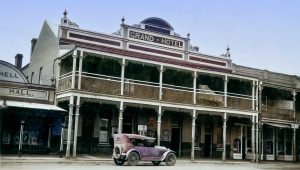
Today a hotel would never dream of advertising it had toilets. But in 1898, Cobar suffered drought, repeated bouts of typhoid, and most domestic and commercial buildings were served by outhouses on the pit or removable pan system, so lavatories were definitely a selling point. Hygienic and far less smelly. The hotel also kept a ‘Second Table’, meaning that meals were served at two sittings. More people could dine at the time most convenient to them. Fancy indeed, even ‘Grand’.
The hotel opened on 3 August 1898, with the event being celebrated with free drinks for all. The first licensee was Halbert James Edgar. He also applied for and was granted a billiards licence. In his first year as licensee, he introduced a billiards competition that was highly successful.
The Edgar family were well-established in Cobar, living in the town for four generations and several decades. Mr Edgar had been the licensee of the Commercial Hotel prior to taking on the Grand, but in spite of his knowledge, connections and experience (and billiards), in 1901 he declared bankruptcy. He subsequently took up wool-classing and became an acknowledged judge of sheep dogs. One of his grandsons, Halbert Emil “Al” Edgar, was shot dead on Barton Street by the police in 1935.
The second licensee was John Conley. The Conleys had a long association with hotels in the Cobar area, and also with mining. Together with Tom Barrass, the Conleys discovered the Brown and Blue Lodes of rich gold at the Peak, just to the south of Cobar. They were smart enough to sell out while they were ahead and invest in other enterprises, such as hotels.

The list of licensees shows it being swapped back and forth between different members of the same family. This was a common practice. It was also common for the publicans to move between the hotels, sometimes staying for only the year of the licence, and sometimes for many years. The licence often passed between a husband and wife. Generally, both were working in the hotel, so it can be assumed that when Mr Edgar was the licensee, his wife Freida was working there, and it is most likely that the family lived on the premises. When Edward Cyfer became the licensee in 1903, he advertised that “The Proprietor and his Wife strive to make this Hotel the home of cleanliness, comfort and civility”. As you would hope.
By 1903, the Grand had acetylene lighting throughout which was a very modern convenience. The Great Western and the Star also had acetylene lighting, but many establishments still used kerosene lanterns or were only party lit by acetylene. Very few homes had it. At this time, the Grand was reported to have 21 bedrooms and stabling for 24 horses. There were underground water storage tanks with a capacity of 40 – 50,000 gallons. The Cyfers kept a dairy cow for daily fresh milk. Mr Cyfer had introduced an American innovation into the commercial room with a long desk against one wall, partitioned for privacy, and with lockers above each partition. The billiard room had the latest and best tables, manufactured by Alcock & Co.
The Grand Hotel was an early subscriber to the local telephone service, being number 14 out of 41 on the list published in 1899. Number 41 was the Police Station. It was recommended a list of the numbers and subscribers be kept beside the telephone.
So far, so Grand – but how grand was it really? It appears it was grand enough for numerous politicians and dignitaries to stay there. When Lord Beauchamp, Governor of the Colony of NSW visited in 1899, the Grand Hotel provided his transport and the balcony was a prime viewing site for the ladies of the town to view the procession. The very next day, it hosted a meeting of pastoralists to address the Minister for Lands, Mr Hassall, on his tour through the region as one of the Governor’s party, to lobby for drought assistance. The Attorney-General, Mr Holman stayed there, and it was also the scene of many important local events. In 1906, The Mayors of Cobar and Wrightville, Aldermen Duffy and Scanlan, used the balcony as a stage, addressing a huge crowd of citizens in the street below on the dire state of water supply and infrastructure (a subject that is doomed never to go away). A very different crowd assembled in 1909 to listen to representatives of the Amalgamated Miners’ Association protest the state government’s treatment of international Labor activist Tom Mann. The Grand bore witness to an even wilder crowd in 1917 when a riot took place with a thousand or more unionists fighting “Wobblies”, the Industrial Workers of the World. Insults and more damaging items were hurled from the balcony.
Against such stirring times were quieter moments when weddings and wedding breakfasts took place at the hotel, as well as farewell dinners and smoke socials or concerts for prominent people leaving town. Travelling salesmen and visiting professionals such as dentists advertised their presence at the Grand Hotel. They would stay at the hotel and hire a “sample room” to meet customers and clients. This practice continued for many decades – health specialists visiting is nothing new, although these days they tend not to see their patients at the pub.
When the big Cobar crash came after World War I, the Grand Hotel was one of the few that did not relinquish its licence. Over the years, it saw many changes and adaptations to the times.
On 24 September 1926, the freehold of the Grand Hotel changed hands. The licensee, Mr M. Heffernan, purchased the building from the estate of Mr Hogan, who had died in 1912. The price was not publicly disclosed, but was said to be “very satisfactory – as far as the purchaser is concerned, anyway”.
Over the years, the building underwent various repairs, alterations and upgrades, including the installation of electrical power. In 1922, the Licensing Inspector commented favourably on the condition of the Grand Hotel, noting the recent acquisition of a hot water service. That same year, under the heading “Victory at the Grand Hotel”, The Western Age described the fight ‘Old Jim’ was having against the cockroaches large and small. In July 1933, the Grand Hotel was undergoing general repairs and renovations with painters “busily engaged in removing the signs of Old Man Depression”. While the Great Depression had global significance, the year 1933 was especially important for Cobar in the economic recovery, as that was the year the New Occidental Gold Mine commenced operations, seeing something of a revival in the population and businesses. Bernard Hale was the licensee of the time. He seemed to be dedicated to the business and apparently believed he should be able to sell drinks whenever people wanted them. In May 1933, he was fined £5 and 8/- the penalty for serving drinks out of hours. It was neither the first nor the last time. Mr Hale did it again on 29th December the same year – this time the charge was for ‘failing to keep his licensed premises closed to the public’. At the beginning of 1932, he had been charged with and found guilty of “allowing a person on the premises during prohibited hours”. He was fined, but no conviction was recorded against him – which may have meant he could do it again. And again.
Life was not all business and court cases. In November 1946, the staff and boarders held a picnic. There were 40 members of staff, enough to hold novelty events, including a yabby fishing competition with two ladies dead-heating as winners.
By 1947, the freehold had gone to Tooheys Ltd. They paid attention to the state of the building, regularly painting and repairing as well as putting in a new elevated tank and sewerage drains. But not everything was squeaky clean.
In 1951, a Royal Commission into the Liquor Trade was held. The Grand Hotel was given as an example of the sale of short leases, greatly profiting both the lessee and the freeholder (in this case, Toohey’s). This was a very questionable business practice.
Over the following decades, the Grand Hotel remained a venue for meetings and events. In 1956, it was the venue for a public meeting to form a Cobar Auto Club and in 1970, darts competitions were held every Thursday at 7:30pm. The Grand also supported many sporting teams and maintained various restaurants. For a while, it had a Chinese restaurant, and then the Haven Inn, with a warm, cosy atmosphere and open log fire for those frosty winter nights. For many locals in the late 1980s and early ‘90s, the Grand Hotel was the place to take the family for lunch.
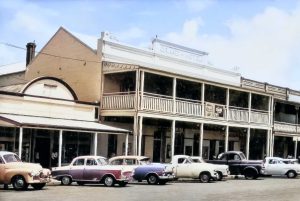
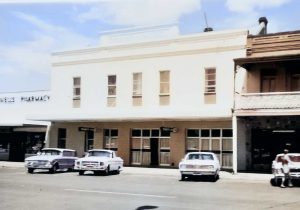
Names associated with the Grand in this era include Sally and Mick Bannister, the Condons, the Paynes (previously at the New Occidental Hotel), and Geoff Carr. During this time, the old balconies were removed and replaced with a cantilevered verandah and a streamlined modern look. The new verandah provided a platform for a Cobar icon – the Big Beer Can. This was placed in 1990. It is 5m tall and capable of holding 22,000 litres of liquid. It won Australia’s ‘best big thing’ competition (there was much enthusiastic voting, especially by locals).
The Grand Hotel has now relinquished its licence. It stands ready for the next phase in its long, sometimes lovely and sometimes louche, life. It may have lost its spirits, but it will never lose its spirit.

The Pubs & Breweries of Cobar
Eighteen hotels are known to have existed in Cobar. Fortunately, they did not all exist at the same time as it may have been harder to get things done.