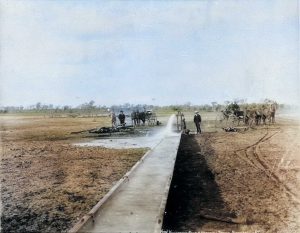
Famous author Henry Lawson stopped at nearby Kerribree Station (site of Australia’s first deep artesian bore) in rags, with his boots worn out, looking for work on his long trek back to Bourke in 1893. Henry immortalised pastoralist W W Davis when he named him in a story as being generous enough to give him tucker and a quid. He swore he’d never carry a swag again.
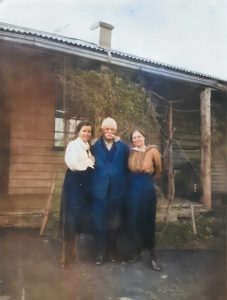
The Youngerina Hotel building was transported to nearby property ‘Mascot’ where it became the family home for the Simpson family, there was a great sketch of Alexander (Sandy) Simpson published in The Land in 1932;
The Old Pioneering Days: In the Years When Bourke Was Young
Drover, Hotelkeeper
The road to the Great Outback became definite prior to the 60’s. The town of Bourke had risen on the banks of the Darling River in ’65 and about this year there came to the town a young man from Scotland. He commenced work with the pioneers, saw the great road go on, and later followed it to beyond Cooper’s Creek.
Alexander Simpson soon had the name of Sandy. His happy disposition carried the name easily, and he was not long in getting into his stride. Stations were formed further west and north-west, and when they were stocked droving had to be done.
The early pioneers had the idea of fattening for market in those early days, and there was very little store cattle droving. Many of the squatters were from Britain, and carried on the traditional idea of fattening.
The Kerribree Drover.
From the 70’s droving fats to market became a serious business, and everybody wanted the best men. There were long dry stages, rivers had to be followed, and in many cases mobs would have to pull up until rain came.
Sandy Simpson was the chosen drover for Kerribree Station, and it was from here that cattle reached Adelaide under his care, and with no loss of condition or numbers. The trip would.be in the vicinity of 700 miles, and was undertaken more than once. Cattle were also roaded to the inside markets of New South Wales as time went on.
Youngerina Hotel.
The railway to Bourke opened about 1884, and Sandy Simpson built an hotel about the same time. He chose as the site of the building a hard rocky ridge, at the foot of which was a fresh water spring. He adopted the name of this spring for his hotel-Youngerina.
The front verandah was so close to the road that it gave the impression of a street. No other building followed or adjoined the hotel, and the closeness to the road was appreciated by the thirsty souls. You could step out of the buggy into the bar. With Sandy’s hospitality, it was hard to pass Youngerina Hotel; there was always a feed, even for the swaggie, and there were hundreds in that district who made for Sandy Simpson’s when they were broke.
With the opening of new railways the traffic on this road fell off to such an extent that the hotel was closed and pulled down.
Back to Droving,
During the great drought years, Sandy Simpson went droving again. His old reputation for care was always with him, and his services were constantly in request. When the roads looked hard, Saltbush Bill exercised great ingenuity in finding feed for his stock. Many outback station managers would say “I had to let him go that way-I may want him myself later.”
Harmony was Sandy’s slogan when droving. Although advancing in years, he kept at it, going as far north into Queensland as the Windorah district for cattle, and from there he made several trips to this State.
In about 1913 Sandy Simpson acquired a Western land lease, which he later got an additional area and settled down to grazing. “Mascot” is now his home, on the back portion of Wapweelah Station.
It is here that the same hospitality is extended as in the days of Youngerina, for the same genial disposition remains with Sandy. He started work in the pioneer days, and has remained in that one and all those years.
His stories of the past are many; he remembers the first gate in the district, and of the cattle yards and gallows posts he has a keen recollection.
The Land in 1932